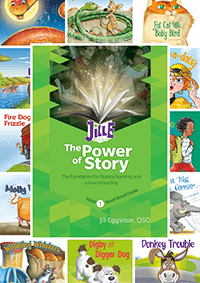
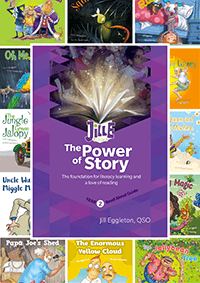
Jill Eggleton QSO, educationist and author of over 1000 children’s books understands how demanding it is to provide “just-right” balanced literacy instruction to a classroom of students with different reading levels and instructional needs. The benefits of reading aloud are tenfold and Jill has spent much of her career making educators worldwide aware of the value they bring by reading aloud to students. We hope you enjoy this article as much as we did.
What could be more simple and enjoyable than reading aloud to children? And yet, I fear, that often this most vital approach is not given the time or place it so richly deserves.
Research shows that reading aloud to children is one of the most important activities for preparing children to succeed as readers. We know that listening to stories stimulates the brain and develops and enriches a child’s vocabulary, building in their brain a storehouse of words. We know, without doubt, that a rich vocabulary is critical to a child’s literacy development, for the fewer words internalised the more limited will be a child’s ability to read and write. This is serious stuff! Sadly, many children only hear media driven language and this does not deliver the rich language weaving through the pages of a read-aloud book.
Reading aloud to children helps them create meaning, the way they do naturally through the ear. It helps them understand how language works and they learn to make sense from print. Knowing how language works is the foundation of successful reading. If children haven’t been read to regularly, they are likely to find reading challenging as they might not expect print to make sense. Then … what is the purpose of learning to read!
There is no doubt that reading aloud stimulates imagination. I find it fascinating that researchers have discovered greater brain activation in children who have been read to. There is also some belief that stirring the powers of imagination may help children transition more quickly to reading books without illustrations! Interesting thought, but one I most certainly believe.
I like to compare hearing a story read aloud, to watching a movie. A movie is passive, the images are created for the watcher. But in a story being read aloud, the listener creates their own ‘brain’ movie. Some say, this can be more exciting and memorable than any great film.
It is essential that our children develop listening skills and reading aloud is a great vehicle for doing just this. Not only listening skills but writing skills as well. Hearing stories read aloud, feeds the world of writing. Children hear language patterns – the rhythm and flow of the story and they are exposed to the literacy devices that the writer has used. How can we expect children to become writers if they haven’t heard the language of writers, using words that paint pictures in their heads?
It is all very well however, to have the theoretical knowledge of the absolute incredible benefits of simply reading aloud to children. But … I believe stories chosen for this purpose need to be carefully selected. Over the years I have read aloud a plethora of stories to hundreds of children and I have discovered, through trial and error, that some work for this purpose and others don’t. I have examined the elements of successful stories carefully and have come to this conclusion. Stories read aloud work well if they use emotion of some kind. They need to ‘grab at the listener’s heart.’ They need to spark imagination, paint visual pictures and be full of rich and vibrant language – words that leap and dive, surge and sway. They need to be stories where the characters are believable- imaginative yes, but believable.
I also love stories where values are naturally embedded in the text. It allows good characteristics to be highlighted and undesirable behaviour to be discussed in a non- threatening way because it is ‘someone else’s problem.’
However, essential to developing a love of listening to a story being read aloud, must be the actual reading. The purpose is for the reader to engage the listeners by wild abandonment in expression, animation and voice characterisations. After all, this is the perfect opportunity to model the strategies of a proficient reader.
My greatest desire is to be assured, that every teacher, in every school, reads aloud daily. Reads aloud carefully chosen stories. Read aloud with wild abandonment and never underestimates the powerful magic of story.
Thanks to Jill for taking the time to share such valuable insights into the power of reading aloud. In partnership with Essential Resources, Jill has created Jill-E Read Aloud for Year 1 and Year 2. Each book is carefully crafted and is perfect for developing vocabulary of sound and rhymes. Kickstart your reading aloud journey today!