The more you read, the more things you will know. The more you learn, the more places you will go.
– Dr Seuss, I Can Read with My Eyes Shut
The humble act of storytelling in early childhood has consistently been found to have remarkable power. In storytelling, we see the beginnings of imagination!
Dr Seuss got it right in the quotation above: learning to read – and being read to – takes you to new places, both literally in terms of children’s development and metaphorically as reading transports us to new vistas. (Dickinson et al. 2012)
Here we see the benefits of storytelling. Not only does it have the power to foster children’s language and literacy development, but it fuels their creativity and imagination. Therefore, storytelling in early childhood is considered an essential practice – and has been since the beginning of time.
Aboriginal children were told stories from an early age. The stories helped them to learn about the air and land, and their people, culture and history. Storytelling is how Aboriginal children learnt. It was a cultural necessity as well as a form of entertainment. Today storytelling remains part of everyone’s childhood.
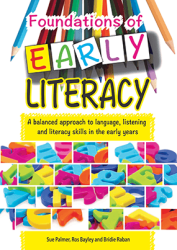
As one of our literacy resources for early years, Foundations of Early Literacy, says: “It’s more important than ever that we immerse children in ‘story language’ by replicating the activities of old: storytelling and reading aloud.”
Here’s why …
The four benefits of storytelling in early childhood
1. Improve language and literacy skills
The first benefit of storytelling is that it develops all aspects of listening in children. The storyteller can model listening skills, like eye contact and body language, to maintain the children’s attention.
Similarly, storytelling is also an effective way to increase children’s vocabulary, grammar and understanding of sentence and story structure. Familiarity with written sentence structure is important as it teaches children to use grammatical cues to predict the words in the text. This helps children when they learn to read.
The authors of Foundations of Early Literacy also explain how children who frequently listen to stories and make up their own are better prepared for later learning.
“By building a store of characters, plots and story-language in this way, children will find it easier to create their own stories in role-play, storytelling sessions and, in later years, when they come to write.”
2. Nurture imagination with storytelling
Another benefit of storytelling is how it powers the imagination. Without illustrations and other visual aids, children have to visualise characters and settings for themselves. For example, what does the big green monster look like?
Furthermore, when children listen to stories, they begin to ask themselves questions such as, “Who did it?” As these questions start to play in their minds, they try to figure out the answer for themselves.
These experiences introduce critical thinking skills like predicting and speculating and spark children’s curiosity.

3. Encourage enjoyment of reading and writing as a benefit of storytelling
Frequent early reading experiences build enjoyment of reading.
Storytelling brings language alive and can create an immersive experience for children. Even more so, when props, music and role-play are involved. The atmosphere draws children in, which in turn, gets them asking for more stories.
As children get older, they want to create, tell, act out or illustrate their own stories. Storytelling and Storymaking in the Early Years says children will become “inquisitive about the print marks on the paper”.
“The intellectual realisation that they can also leave a trace that can be revisited becomes a fascination for young children if they have the opportunity, resources, encouragement and support.”
There are later benefits associated with developing a love of reading:
- Greater self-confidence as a reader.
- A positive attitude to reading, which is linked to reading and writing achievement.
- A better understanding of other cultures.
4. Develop cultural understanding through storytelling
As mentioned previously, throughout history, storytelling has been a way people have passed on their culture and traditions. It is no different today – although the way we do so might be different.
Aboriginal and Torres Strait Islander stories are a way for children to learn about their local history and culture. It is also a means for introducing meaningful vocabulary, such as place names. Storytelling can help children develop a sense of identity and a connection to Australian people and land.
Storytelling also helps children learn about other cultures. Imagine telling the ancient Indian tale of Ramayana during Diwali (the Hindu festival of lights). How would this open a child’s eyes to other cultures?

Benefits of storytelling are well-established
The benefits of storytelling in early childhood are multiple and well-established. As it is summed up in Storytelling and Storymaking in the Early Years, “‘Narrative’, therefore, is at the core of our human existence. Human beings learn, grow and thrive on stories”.