Foundational skills like spelling, handwriting, and sentence writing are critical for older students’ progress. For educators in New Zealand, How to Teach the Foundational Skills of Writing offers valuable support for struggling writers. By focusing on these foundational writing skills, teachers can help students build confidence and achieve academic success.
This blog explores the reasons why foundational skills matter and provides practical strategies for implementing effective interventions in the classroom. Learn how to support your students’ writing development and set them up for long-term success.
Do foundational writing skills matter for student progress?
Just how important are the foundational skills of spelling, handwriting, and sentence writing, to progress in writing generally?
Quite simply, mastery of these skills is crucial to student progress, confidence, and motivation. Consider the metaphor of a house – we must build strong foundations, or the house will fall over later on.
There are two main reasons why we must prioritise the teaching of these skills – working memory and readability.
Working memory
The first reason why these skills are important, is because of the characteristics of working memory – the memory system used in all new learning and thinking processes. Working memory is:
- highly limited in its capacity – it can only hold a few elements
- limited in time – it can only hold these elements for a few seconds
- easily interrupted – it’s not good at multi-tasking.
Working memory is, therefore, easily overloaded during a writing lesson. For example, imagine an older student who has not yet mastered letter formation to automaticity. The teacher may be focusing on some age-appropriate goal, such as the use of a rhetorical question, but this student’s working memory system is entirely occupied with formation – where to start each letter, which way to go, how to sit each letter on the line, and so on. In this situation, nothing can really be learnt. Instead, the student will experience frustration, and possibly shame, as they are unable to focus on the age-appropriate goals the teacher has set.
Readability
The second reason why these skills are important is that our students’ writing needs to be readable. Students must be able to read their own work, as re-reading is integral to revising. And of course, readers must also be able to read the writing. Consider the exam marker or potential employer – frequent errors will distract them from the writer’s message and may create a poor impression. Students may be judged to be less motivated, or less intelligent than their same age peers. This is of course unfair as errors with these skills are not usually a reflection of intelligence. Instead, they’re the consequence of an inappropriate programme in the junior years at school, and/or difficulties such as dyslexia or dyspraxia.
To find out more watch Jared Cooney Horvath deep dive into the significance of lower levels skills for writing progress.
Why build the foundations first?
Because these foundational skills are so crucial to writing development, I urge junior teachers to take the time they need to support students to master these skills, and not to jump into the ‘deeper features’ too soon. Key mantras include: “Students cannot run before they can walk”, and, “We are building the foundations to the house, we want strong, solid foundations, not speedily built, wobbly ones.”
When we do teach these skills well, and our students have mastered them, we’ll know because the page will be tidy and legible. There will be many correct spellings, grammatical sentences and correct use of capital letters and full stops. So… it’s time to break open the champagne!
We can celebrate because we have just got our students through the most pivotal, “make or break” years of their writing careers. Students who have mastered the foundations will no longer be dragged down by lower-level constraints. Their working memory systems will now be free to focus on other, more advanced writing skills.
To learn more, check out my article on The Education Hub: Effective writing instruction in the junior primary years.
How can I support foundational writing skills for older students?
What can be done in the middle and senior years when we inherit a writer who has not yet mastered handwriting, spelling, or sentence writing? Remediation is often difficult as incorrect versions have been practiced and have become embedded. We need to address these difficulties and confusions as soon as possible, without destroying the student’s self-confidence and motivation.
Confidence is often a big issue, of course. Older struggling students have already spent several years feeling overwhelmed and unsuccessful during writing lessons. Often, they are reluctant even to come up with ideas for writing. When you ask them what their first sentence will be, they say, “I dunno” or shrug.
Then, when these students do put pencil to paper, they may be dependent on the teacher for every word, or may write with chaotic layout and poor handwriting, barely readable spelling, and sentences which are ungrammatical or incoherent. All in all, the experience is demoralising, for these students as well as their teachers.
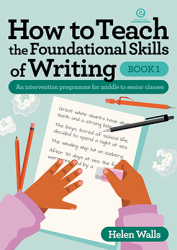
So, what can the busy classroom teacher do for these older struggling writers, who so urgently need the best possible programme? How to Teach the Foundational Skills of Writing is a research-informed resource developed to remediate the foundational skills and rebuild writing confidence, so that we begin to see a change in the writer’s skills over just ten weeks.
How does the How to Teach the Foundational Skills of Writing programme work?
First, by grounding instruction in age-appropriate and exciting topics:
- Apex predators in weeks 1–5.
- True stories of human survival in weeks 6–10.
Second, by teaching spelling, starting with CVC words but moving at a faster pace than most junior sequences, and including words that relate to the topic for writing. For example, in week one, students will study words with short vowels and some double consonant sounds, all about animal hunting habits: kill, skill, pack, attack.
Discover more about spelling and its significance to writing in my complimentary article on The Education Hub.
Third, we’ll teach cursive handwriting so that lessons feel age-appropriate, and the writers will be proud of the way their writing looks. We’ll also harness the power of cursive to support spelling progress. In week one, we’ll teach the linking of hu, un, ki, and ac, before writing the words – hunt, kill, skill, pack.
Sentence-combining: a fun and effective way to teach grammar
The final part of the daily lesson teaches students how to work with the sentence. For this we use sentence combining, a fun and evidence-based approach with numerous benefits.
- Sentence combining removes the barrier of students having to come up with their own original ideas while still giving them experience with sophisticated grammatical structures.
- Exercises are practiced orally at first – so that poor transcription skills need not hold anyone back.
- The sentence combining examples, pre-planned in our resource, have been developed to reinforce the spelling of words too. In week one, students will revisit words such as hunt, kill, pack, as they combine the two kernel sentences: Orcas hunt in a pack. Orcas kill in a pack.
For more information on the benefits of sentence combining, read this research article by Bruce Saddler and Kristie Asaro-Saddler on the benefits of sentence combining.
Oral sentence combining practice is followed by students writing the new combined structure. During this part of the lesson, we remove constraints for less proficient spellers by using the “disappearing sentence” technique, where the teacher rubs out easy to spell words from their modelled example but leaves the others available for copying.
As students complete their sentences for the day, we’ll use Fast Feedback, an evidence-based feedback system which can accelerate progress and build confidence in a matter of weeks.
In How to Teach the Foundational Skills of Writing you will find all that you need to implement this intervention with ease. Use the resource, with confidence, to transform achievement and motivation for every student, and to make writing a highlight of every school day.
Conclusion
Foundational writing skills are essential for student success, and as this blog has shown, targeted intervention can make a significant difference – no matter the student’s age. By prioritising spelling, handwriting, and sentence writing, teachers can unlock students’ potential, boost their confidence, and set them up for long-term academic achievement.
With research-backed resources like How to Teach the Foundational Skills of Writing, educators have the tools to support struggling writers and create meaningful progress in just weeks. Whether you’re teaching younger students or working to remediate gaps in older learners, investing in these essential skills is an investment in their future success.
About the author
Dr Helen Walls is a professional learning facilitator and educational researcher, with 20 years’ experience working in schools. She is committed to raising achievement in writing by sharing evidence-based, practical methods to engage every student. Helen is managing director of The Writing Teacher, a consultancy that provides writing workshops and resources for teachers, all accessible online. She is also a member of the Massey University school support team. For her PhD thesis, Helen conducted two empirical studies into the teaching of writing, which included a trial of the Fast Feedback Formative Evaluation System outlined in this book. She has published with The Australian Journal of Learning Difficulties and The Education Hub.