Struggling to spark enthusiasm for writing in your English classroom? You’re not alone. Many secondary teachers face students who enter Years 7–9 already disengaged. They see writing as a chore, not a chance to be creative.
But what if the key is letting them write about what matters to them? Interest-based writing taps into students’ passions, helping them rediscover confidence, creativity and genuine joy in putting words on the page. In this blog, discover practical ways to re-engage reluctant writers through student choice, authentic tasks and meaningful writing projects that still hit your curriculum goals.
Why do many students lose the joy of writing in lower secondary school?
For many teenagers, writing shifts from creative exploration to compliance. Assessment driven tasks, rigid essay structures and prescriptive prompts can turn writing into a source of anxiety rather than expression. As one Teaching and Learning Research Initiative (TLRI) study found, students “… recognised a distinct improvement in their writing when they were interested in the subject content, and there was some ‘fit’ between their self-identity and the subject area.” (Boyask, Quinlivan & Goulter 2007)
Research from TLRI highlights that students who view writing as disconnected from their identity or interests are less likely to persist with complex writing tasks. Likewise, literacy expert Dr Graham Parr from Monash University notes that, “Effective teachers select writing topics carefully and strategically so as to engage, motivate and challenge students … related to either the students’ own experiences, understandings, and interests.” (Gadd, 2017)
The challenge for secondary English teachers is not that students can’t write, but that they no longer want to. The solution lies in rekindling that sense of purpose and joy.
What is interest-based writing and how does it re-engage reluctant writers?
Interest-based writing gives students the power to write about what genuinely matters to them – a shift from teacher-directed to student-centred writing activities and learning. Whether it’s social justice, gaming, climate activism, or creative genres like sci-fi or fan fiction, choice reconnects students with their own voice.
- This approach aligns with the Australian Curriculum: English, which emphasises that by Level F10, “Students create texts, drawing on their own experiences, their imagination and information they have learned.”
- Similarly, New Zealand’s refreshed English learning area encourages authentic, purposeful writing connected to students’ lives and communities.
Research from NZCER confirms that when students see value and relevance in writing tasks, their self-efficacy improves, and they write with greater confidence. In other words, interest-based writing transforms “I have to write” into “I have something to say”. (Hodis & Hodis, 2022)
How student choice can spark creativity and writing confidence
Giving students a degree of choice is not about abandoning structure, it’s about balancing freedom with focus. In a TLRI study, students reported that being able to choose their writing topic was the most significant factor in shaping their attitude toward writing. (Parr and Gadd, 2018)
When learners are trusted to make decisions about genre, purpose and audience, student engagement in literacy often follows. Imagine a class where one student writes a persuasive article on esports while another crafts a short story inspired by Māori mythology. Both are working toward the same curriculum goals, but through pathways that reflect their interests.
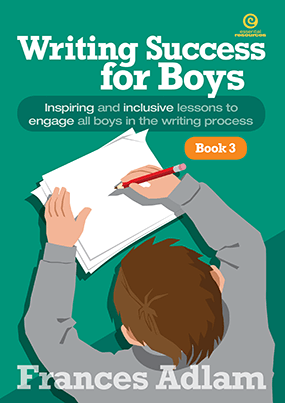
Essential Resources’ Frances Adlam captures this approach perfectly in Writing Success for Boys – Book 3 (Years 7–9), where fun and creativity take centre stage. Her Bridge to Writing philosophy connects teaching literacy in secondary schools, rhythm and master teaching – showing how purposeful, inclusive writing tasks can reignite enthusiasm, particularly for re-engaging disengaged learners.
Balancing curriculum goals with student-driven writing projects
Here are a few ways to embed student-centred writing while maintaining academic rigour.
Start with student voice.
- Survey your class – what do they care about?
- What topics spark emotion or curiosity?
- Use these ideas to co-design writing units.
Offer genre pathways.
- Within a unit, give options.
- After exploring narrative structure, for instance, students could create a short story, a film review or a podcast script.
Use authentic audiences.
- Have students write for real readers – peers, school blogs or community newsletters.
- Writing for real purpose, and a real audience builds real effort.
Model writing and thinking aloud.
- As Dr Helen Walls, (The Writing Teacher) suggests in her blog, Learning to write – it’s time to change how we teach, skilled writers “re-read and revise throughout the drafting process – from the very first sentence.”
- Let students see that process in action.
Provide exemplars and structure.
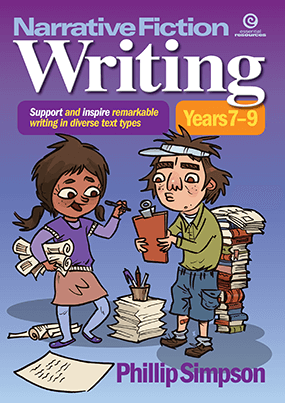
- The Narrative Fiction Writing series by Phillip Simpson is an excellent resource for modelling diverse text types – from adventure and fantasy to gothic and historical fiction.
- Each book includes engaging exemplars and discussion prompts that encourage students to reflect on the structure of the text – including both surface and deeper features.
Build writing stamina through micro-tasks.
Use five-minute, free choice prompts once a week to normalise regular, enjoyable writing.
Together, these strategies can help transform writing into an authentic practice – something students do because they have ideas to express, not merely assignments to complete.
Balancing curriculum goals with student-driven writing projects
Secondary English teachers across New Zealand and Australia face the dual challenge of upholding curriculum standards while engaging students in English lessons, who are often switched off. Interest-based writing doesn’t replace the curriculum – it fulfils it in more meaningful ways with meaningful writing experiences.
Within the Australian Curriculum: English, students must learn to write for various purposes and audiences, using appropriate structure and language features. By giving students ownership of context – say, a campaign speech on environmental change or a short story exploring identity – teachers can meet these same outcomes while boosting motivation.
The NZ NCEA Literacy standard (US32405) similarly requires students to “write texts to communicate ideas and information” for different purposes and audiences. Interest-based writing directly supports this standard by encouraging authentic writing tasks that blend purpose, structure and creativity.
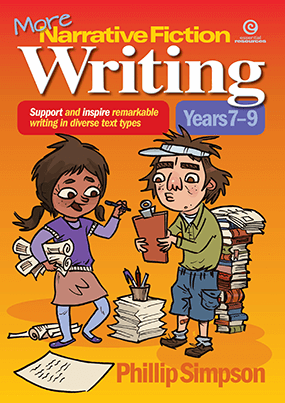
Essential Resources’ More Narrative Fiction Writing – Book 2 extends this connection. Simpson’s inclusion of genres such as drama, comedy and diary writing provides flexible entry points for diverse learners, demonstrating how structure and creativity in the classroom can coexist productively.
When students rediscover writing joy, teachers feel it too
When reluctant writers begin to see themselves as authors, the atmosphere in the classroom changes. Writing becomes purposeful, revision becomes thoughtful, and classroom discussions deepen.
As the TLRI summarises, “… learners’ self-belief as a key motivator”, and students must first believe their writing matters, for motivation and engagement in what they write to follow. When we design writing programmes that honour student interests, we create space for that belief to grow. (Zepke, Leach & Butler, 2010)
And teachers feel it too. The energy lifts, creativity flows, and assessment pieces begin to show genuine voice. Engagement and joy are not the by-products of effective writing instruction, they’re the foundation of it.
Practical, ready-to-use support for writing engagement
If you’re looking for materials that make writing feel more inviting for students, two resources stand out. Writing Success for Boys – Book 3 (Years 7–9) offers purposeful, inclusive approaches designed to spark renewed enthusiasm, especially for students who have struggled to connect with writing. Alongside it, the two-book series Narrative Fiction Writing provides clear structures and thoughtful examples that help build both confidence and creative expression.
Used together, these resources give you a balanced mix of interest-driven guidance for students and practical support for your own planning. They can help shift the tone of your classroom toward a space where every learner sees themselves as a writer, one confident step at a time.
References
Australian Curriculum, Assessment and Reporting Authority (ACARA). (2021). Australian Curriculum: English (Version 8.4) – F-10.
Australian Curriculum, Assessment and Reporting Authority (ACARA). (2021). English | Version 9 – Understand this learning area
Boyask, R. et al. (2007). Write-on! Investigations into relationships between teacher practice and student writing. Teaching and Learning Research Initiative.
Gadd, M. (2017). What does an effective teacher of writing do that makes a difference to student achievement? Set: Research Information for Teachers, 1, 37–45.
Hodis, F. A. & Hodis, G. M. (2022). Key factors that influence students’ motivation to learn: Implications for teaching. Set: Research Information for Teachers, 2, 37–41.
Ministry of Education. (2025). The New Zealand Curriculum: English (Years 0–6).
New Zealand Qualifications Authority. (n.d.) US 32405 Write texts to communicate ideas and information.
Parr, J. M., & Gadd, M., with Carran, L., Robertson, J., Watson, K., Gendall, L., & Ali, Z. (2018). Generating positive outcomes by Year 5 to 8 priority learners in writing: An inquiry into effective teacher practice. Teaching & Learning Research Initiative.
Zepke, N., Leach, L., & Butler, P. (2010). Student Engagement: What Is It and What Influences It? Teaching and Learning Research Initiative.