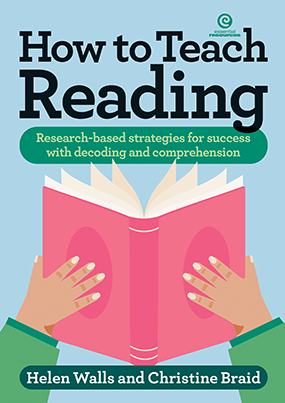
It’s no secret that reading strategies and writing go hand-in-hand – but the latest science-backed research shows us just how much! Deepen your structured literacy expertise with Dr Helen Walls, as she unpacks the top six takeaways from her latest release How to Teach Reading, co-authored with Dr Christine Braid. Explore phonemic awareness alongside print, understand the alphabetic principle, learn the impact of rich reading exposure, discover how dyslexic students process speech, and why teaching handwriting boosts reading outcomes.
What I learnt in writing this book
I am particularly proud of How to Teach Reading, which I wrote along with my colleague Dr Christine Braid. Our overview of current knowledge leads on to practical ideas to apply in the classroom. What follows are six key takeaways from the book that I hope will be useful to you now and in years to come.
1. Phonemic awareness skills are crucial for learning to read; teach them with reference to print
Having phonemic awareness means being able to work with small sounds in words, such as by identifying words that start with the same sound, or by segmenting a word into phonemes (eg, cat becomes /c/ /a/ /t/).
Gaining skills in phonemic awareness is seen as a precursor to learning to read, but it is important not to wait for phonemic awareness to develop before introducing students to print, for two key reasons:
- First, a printed word can support a student’s memory of phonemes.
- Second, by integrating the two forms of skill in one lesson, we can make the most of our valuable teaching time (Savage 2021).
We can connect sounds to print from students’ first days of school by scribing for or reading to them, and talking about how we spell the sounds. For example, when reading a big book about a snake to the class, say, “I can hear an /s/ sound and look at the letter that is spelling it!”
2. Students need to have phonics knowledge and understand the “alphabetic principle”
Knowing phonics and phonics sounds is essential for learning to read. So is understanding the “alphabetic principle” – that is, understanding that we use letters to record the sounds in spoken words.
Understanding this principle enables “self-teaching”. During this vital stage in learning to read, students begin to look for new patterns (or grapheme–phoneme correspondences) for themselves (Share 2004).
Many teachers have observed self-teaching at work. It is that moment when students begin to read patterns and words quite fluently, including some that you have not yet taught.
On the flipside, some students have great difficulty remembering and using even the patterns you have taught – no matter how explicit and engaging your programme has been. Some of these students may have dyslexic tendencies. Others may simply be confused, not understanding what on earth is going on with these squiggles and sounds, and desperately trying to remember a set of abstract knowledge items … for what?
In sum: To give your students the best start in reading, teach phonics knowledge and be explicit about the alphabetic principle too. This may sound complicated, but it’s not. In brief, when modelling reading, say, “I can look at the letters and think of the sounds they can spell”; and when modelling writing, say, “I can listen to sounds and choose letters to write”.
3. Extending language through exposure to a range of books is essential
Language is crucial for success with reading. In their first months of learning to read, decoding is easier when students already know a word orally. From about Year 4, vocabulary knowledge is one of the strongest predictors of success with comprehension.
Exposure to the language of books is important. This is because books include more sophisticated words than speech. According to Shaywitz (2020), for example, even children’s books contain about 50% more rare words than the speech of university graduates.
Matthew effects are another important consideration. This is the term used for the phenomenon where good readers read more, which leads to further progress, while others read less and fall further behind. One study of Year 2 (Grade 2) readers demonstrated that the total number of words read in a week ranged from 16 for the least skilled reader to 1,933 for the most skilled (Allington, cited in Savage 2021).
So how might we expose students to sophisticated written language, when they have not yet mastered decoding? First, we can read them many high-quality picture books and non-fiction texts. Second, we can use shared reading of big books (someone please find me a copy of The Meanies) and levelled readers (which could supplement the use of decodable books during small-group lessons).
4. To understand dyslexia, we need to know about “allophones” as well as phonemes
While we love segmenting for spelling, consider that words are not actually made up only of a limited number of phonemes. Instead every word has an infinite number of merging sounds called allophones.
To illustrate: Segment the word cat, /c/ /a/ /t/. Next, say cat smoothly and slowly and notice how your mouth moves between the dominant phonemes, with many other sounds “in between”.
This exercise demonstrates that the notion of phonemes is actually a simplification – one that makes it possible for us to represent words in print. Our written words would be far too long if we needed a symbol for every allophone!
Often, dyslexic students have difficulty working with phonemes as they hear words as “pulses” or “bubbles” of sound, which are coated or “lacquered over” with allophones (Shaywitz 2020). In addition, many of them find it difficult to retrieve words for speech from memory and to make the unconscious movement of the mouth muscles needed to produce speech sounds.
In How to Teach Reading, we dedicate a chapter to instructional methods that support students with reading difficulties. Our starting point here is to increase understanding of how a dyslexic student perceives and produces speech sounds.
5. Teach knowledge
Background knowledge is essential for reading comprehension, as it enables readers to create an in-depth and coherent understanding of what they read (Cain 2021).
Consider, for example, this commentary of a surfing competition:
John Florence took the lead as he made a massive bottom turn, sped past a huge section, and finished with a hack off the top.
A reader with little knowledge of surfing may be able to answer questions about which tricks were performed (eg, a hack) without really understanding what these are. In contrast, an experienced surfer reading the same text would be able to imagine the wave and grasp just how impressive John Florence’s performance was.
This example demonstrates why you need to make the most of your teaching time to build background knowledge in all curriculum areas. Then set reading and writing tasks to reinforce the topics your students study in science, social studies and so on.
An added bonus is that students love learning “stuff” and having interesting “stuff” to read and write about.
6. Teach writing
Graham and Hebert (2010) demonstrated that teaching writing may have a greater impact on reading comprehension than teaching reading comprehension directly. In a meta-analysis of “write to read” interventions, they calculated a combined effect size of 0.37; compared with 0.32 for reciprocal teaching, 0.17 for “reading programmes” and 0.10 for teaching vocabulary.
Remember too that when students write, it is best if they write by hand. Handwriting activates the brain’s orthographic mapping pathway and helps to secure sound–letter correspondences in memory, whereas typing does not (James and Berninger 2014).
Finally
How to Teach Reading offers many meaningful insights from research and translates these into a wide range of practical reading strategies to apply in your classroom. Use this book, along with your own intuition and creativity, and watch your students thrive.
References
Savage, R (2022) Teaching children to read. In MJ Snowling, C Hulme and K Nation (eds) The Science of Reading: A handbook (2nd ed). Wiley Blackwell. DOI: 10.1002/9781119705116.
Share, D (2004) Orthographic learning at a glance: on the time course and developmental onset of self teaching. Experimental Child Psychology 87: 267–98.
Shaywitz, S (2020) Overcoming Dyslexia (2nd edn). New York, NY: Penguin Random House.
Cain, K (2022) Children’s reading comprehension difficulties. In MJ Snowling, C Hulme and K Nation (eds) (2022) The Science of Reading: A handbook (2nd ed). Wiley Blackwell. DOI: 10.1002/9781119705116.
Graham, S and Hebert, M (2010) Writing to Read: Evidence for How Writing Can Improve. Carnegie Corporation Time to Act Report. Washington, DC: Alliance for Excellent Education.
James, KH and Berninger, VI (2014) Brain research shows why handwriting should be taught in the computer age. LDA Bulletin 51(1): 25–29.
About the author
Dr Helen Walls is a professional learning facilitator and educational researcher, with 20 years’ experience working in schools. She is committed to raising achievement in writing by sharing evidence-based, practical methods to engage every student. Helen is managing director of The Writing Teacher, a consultancy that provides writing workshops and resources for teachers, all accessible online. She is also a member of the Massey University school support team. For her PhD thesis, Helen conducted two empirical studies into the teaching of writing, which included a trial of the Fast Feedback Formative Evaluation System outlined in this book. She has published with The Australian Journal of Learning Difficulties and The Education Hub.