What’s your go-to way to spark creativity in young writers?
One of my favourite ways to inspire young writers is to use published works as inspiration.
Collecting great sentences or paragraphs that authors have carefully crafted and which capture my imagination is one of the best things I do for myself and have done with students.
Riffing off the work of these authors gives young writers the chance to write like a particular author and to be mentored by that writer via their writing.
What’s one quirky or unexpected writing habit you’ve noticed in students?
It’s wonderful to see young writers experiment with fresh images rather than using cliché statements or tired techniques.
We can show students how to create their own technique book of ideas, that might be too short for a story but really good as part of another story. Helping students to be curious about words and about the world is the best thing for writers.
What’s a simple tip teachers can use tomorrow to build stronger sentence skills?
Sentence combining is a teaching technique that can become a weekly exercise. It is vital that teachers and students understand the notion of the clause in the sentence for this activity to work.
The teacher would model for students by using two or more simple sentences that can be combined in a number of ways. Simple sentences can be combined into compound, sometimes into complex, and usually into expanded simple sentences with adverbial phrases, that can be used in different parts of the sentence.
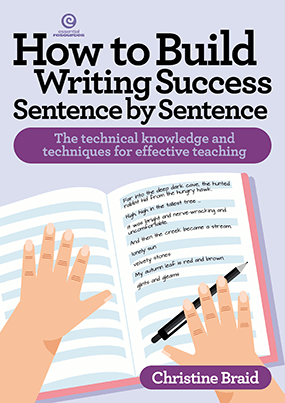
These exercises can be done as a whole class, in small student working groups or pairs, or by students individually. Get students to share their finished products and to select which they like best and why. There are many examples in How to Build Writing Success Sentence by Sentence.
How do you help teachers feel confident teaching the technical side of writing?
I like to help teachers understand what makes a sentence a sentence so they can help their students.
Understanding the clause is such a key to being better at combining clauses for variety in writing. The best thing I have used is the coloured card system that uses strips of card for the phrases in a sentence: subject phrase and verb phrase to make a clause – and then adding to verb phrase with another card for adverbial phrase. Once we have a clause, we can join using conjunctions cards to make compound and complex sentences.
Having punctuation marks on small white cards is also an important part of the system. Watching teachers manipulate the cards to get an understanding of sentences has shown me that using concrete materials helps at all stages of learning.
What excites you most about helping teachers and students build writing success?
I love the aha moments that we all have as we learn more about how writing works.
I love seeing teachers and their students get the concept of sentences and ask questions that show they are working things out – and when they take ideas and make them their own in the classroom. The questions from teachers and students help me to deepen my understanding and challenge me to find other ways of explaining things if necessary. It feels like ‘ako’ – where we learn from each other.
Top tips for improving in writing and teaching writing?
- Read children’s literature – fiction and non-fiction – it’s one of the best things we have at our fingertips for being better teachers of writing.
- Listen to authors talk about their craft.
- Be curious about things around us and gather ideas.
- Get better at writing by doing it!
About Christine Braid
Dr Christine Braid has 40 years’ experience as an educator, including 12 years as a classroom teacher and 25 years as a teacher educator with a focus on literacy teaching. In her academic studies, she has specialised in literacy: she has a Diploma of Children’s Literature, her MEd thesis looked at using picture books for developing comprehension discussion with older primary students and her PhD examined the influence of teacher knowledge and practice on literacy outcomes for new primary students. Combining her practical and her experience, Christine works with teachers to promote systematic and explicit teaching and to provide opportunities for incidental learning. Christine has a particular enthusiasm for finding ways to inspire teachers and children using books.