Critical reflection in ECE is a crucial aspect of education, helping early childhood educators refine their teaching strategies and achieve better outcomes for children. Aligned with the Early Years Learning Framework (EYLF), critical reflection supports ongoing professional development. By evaluating their experiences and incorporating feedback, educators can continuously improve their approaches to teaching, curriculum planning and family engagement. This blog explores the importance of critical reflection, providing practical strategies to cultivate a reflective culture in early childhood settings. Furthermore, it highlights its role in fostering inclusive, high-quality learning environments.
What is reflective practice in early childhood education?
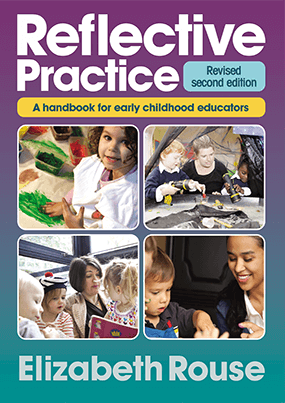
When educators engage in reflective practice, they enhance their methods to achieve high-quality outcomes for children and families. They consider connections between philosophy and practice, integrating new understandings, theory, and research. Critical reflection in ECE and ongoing professional learning are one of eight key principles in the Early Years Learning Framework (AGDE, 2022). As Elizabeth Rouse explains in her book Reflective Practice – Revised second edition, effective teachers continually improve their practices. Reflective practitioners take an inquiry stance in that they actively search for understanding and are always open to further investigation. Teachers need to be constantly updating and improving their practice.
Reflection can be defined as the deliberate, purposeful, metacognitive thinking and/or action in which educators perform to improve their practice.
Critical reflection on the other hand is a deep process of meaning-making. It involves engagement with diverse perspectives and brings together an understanding of philosophy, theory, ethics and practice. Educators interrogate the influence of these fields on early childhood education practice. In turn, they also consider how they have shaped decision making in relation to young learners, their families and educators.
Reflection is an individual critical thinking process based in experience. The reflection process consists of three stages:
- returning to an experience
- attending to feelings about the experience
- re-evaluating the experience.
Reflective practice occurs in the moment, when educators see events unfolding and make conscious decisions to make immediate changes. It also occurs when educators reflect on the event to analyse and understand what occurred, then identify future changes. Reflective practice can involve educators reflecting on their interactions with children, families and colleagues. It also involves educators reflecting on their planning and teaching, on children’s learning and their interactions with their peers.
What does a reflective culture look like in early childhood education?
Creating a reflective culture in ECE requires educators to understand the role continuous improvement has in supporting educational outcomes. A reflective culture in early childhood education involves educators collaborating to improve the practice within themselves and across the service. It also recognises that educators bring different skills, strengths and understanding to the professional learning community.
Dewey describes 3 attitudes that form the basis of reflective practice:
- open-mindedness – a willingness to consider new evidence as it occurs and to admit the possibility of error. It involves being open to other viewpoints, appreciating that there are different perspectives on a particular situation or event. Part of open-mindedness is being able to relinquish needing to be right and being open to changing one’s own viewpoint.
- responsibility – the careful consideration of the consequences of one’s actions, especially as they affect children and families. It is the willingness to acknowledge that one’s decisions as an educator will impact on the lives of children and families in both foreseen and unforeseen ways. This may include curriculum, instruction, assessment, organisation and management.
- wholeheartedness – a commitment to seek every opportunity to learn and a belief that one can always learn something new.
How can educators foster a supportive environment for critical reflection in ECE?
Educators can foster a supportive environment for reflection by:
- following a continuous cycle of documenting and assessing, planning, implementing, reviewing and evaluating their program and their practice. They should also identify strengths and areas that can be improved.
- gathering a range of evidence on their own practice. This may include documented assessments of children’s learning and development, photographs, listening to children’s feedback and seeking feedback from families. It might also involve asking peers and colleagues for their reflections on their practice
- demonstrating a willingness to give and accept feedback and constructive criticism. It is vital to see feedback not as judgement, but as a learning opportunity for developing and enhancing practice
- seeking advice from others to identify strengths and gain suggestions for constructively moving forward. This should consider the best interests of children, families and the team.
- sharing thoughts and ideas with others and listening to peers and colleagues.
- committing to always doing their best and not resting on past successes, but seeing these as stepping-stones to greater successes
- continually looking for new or innovative ways to improve practice
- making judgements that are informed by self-reflection, evidence and research rather than by taken-for-granted practice
- valuing lifelong learning and continually striving to gain new knowledge about themselves, their practice and early childhood education.
- seeing the value of creating and participating in professional learning communities, networks and communities of peers.
What role does leadership play in cultivating a culture of reflection?
A culture of reflection is shaped by the vision, values and beliefs of the leadership across the setting. A good leader builds a culture of ongoing professional learning, that values the strengths everyone brings to the team. They provide opportunities for collaborative practice and create a culture where reflective practice is recognised as key to educator’s work. For more information on the role of an educational leader, check out this blog.
What are some effective tools and strategies for encouraging reflection among educators?
Reflective practice is a skill that needs to be learnt and developed. It is important to build a range of strategies for engaging effectively and meaningfully in reflective practice. Below is a list of possible ways to engage in reflective practice:
- writing a reflective journal
- actively and purposefully engaging in reflective conversations with peers and colleagues
- keeping a personal professional portfolio
- reading and analysing case studies of practice
- writing reflective responses to readings of professional literature
- analysing and reflecting through videos and photographs
- peer observations (and/or peers observing and critiquing your teaching).
For more advice on how to implement good planning and reflective practices, dip into Intentional Teaching.
Conclusions about critical reflection in ECE
In conclusion, reflective practice is a powerful tool in early childhood education that drives continuous improvement in teaching strategies. By engaging in critical reflection and aligning their practice with the EYLF, educators can foster better outcomes for children. As they incorporate new understandings, theory and research into their everyday practice, educators build a supportive environment that promotes inclusion. Ultimately, reflective practice ensures that early childhood education remains responsive and focused on the needs of every child. For more information on reflective practice check out this blog.
References
Australian Government Department of Education [ADGE] (2022). Belonging, being and becoming: the early years learning framework for Australia v2.0. Australian Government Department of Education for the Ministerial Council.
Dewey, J. (1933). How We Think: A Restatement of the Relation of Reflective Thinking to the Educative Process. Heath & Co Publishers.
Rouse, E (2024). Reflective practice: a handbook for early childhood educators (revised second edition). Essential Resources Educational Publishers,
About the author
Elizabeth Rouse is an Associate Professor in early childhood education at Deakin University, where she is working in the area of initial teacher education. Her main areas of focus are in curriculum and pedagogy, particularly as these connect with developing practices and teaching approaches that concentrate on the whole child. She has published a number of books, book chapters, journal articles and professional papers in early childhood education especially relating to infants and toddlers, children's wellbeing, professional practices and partnerships.