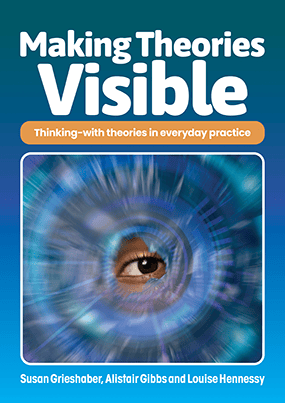
Does trying to think with theories in the hustle of your early childhood setting feel like too much of a juggle? You’re not alone, and the authors of Making Theories Visible are here to save you mental gymnastics.
In this light-hearted Q&A, Susan Grieshaber, Alistair Gibbs and Louise Hennessy share what first drew them to early childhood education, the myths about theory they’d love to bust, and the theorists they’d most like to chat with over a coffee.
What first sparked your interest in early childhood education, and what keeps you in it today?
Susan: The first time I visited a preschool was when I was in my late teens and I was in awe. There were no kindergartens or preschools in the remote place we lived, and I didn’t get to go to one. The magic of learning keeps me in it.
Alistair: Whilst working in a bookshop managing the children’s section, I was able to see the deep connection between children and literature which fascinated me. The thing that keeps me in ECEC is the sheer power we can have to encourage societal change through teaching children and families.
Louise: I have worked with children in one capacity or another my entire working life. My interest has always been in the capacity of education to change a child’s life, and ensuring all children have the means to access and participate in quality early childhood education.
In what ways can thinking-with theories produce better outcomes for children and deepen families’ understanding of children’s learning and development?
Susan: By strengthening educator understanding about theories and their place in everyday thinking and learning.
Alistair: Thinking-with theories can produce better outcomes for children as it allows for the opportunity to have a more dynamic and holistic view of children’s current developmental accomplishments and needs.
Louise: Recognising and applying theoretical thinking to children’s learning brings new perspectives and understanding to everyday practice that deepens opportunity for children to flourish.
What is the most common thing you hear educators say about theories that you would love to change?
Susan: For me, it’s that there’s a theory-practice divide.
Alistair: The most common thing I hear from educators is more about what is unheard. Educators have so much professional knowledge – however when they share their insights with children, families and colleagues, there is an unspoken theoretical layer in what is being shared. I would love to support building confidence to discuss theory at the forefront of developmental conversations.
Louise: I would like to change the perception that theory is complicated, difficult to understand and too hard to think-with in practice. Our book will hopefully help illuminate that theory is present and already happening all the time – and therefore not too complicated and difficult to be recognised in everyday practice.
Could you suggest one small thing an educator could do tomorrow to start thinking-with theories?
Susan: Be open to the idea and try it!
Alistair: My suggestion would be to stop and take a breath. We will always begin with the theories we are most comfortable with. The developmental pieces that can appear surface level within our observations. Note these down as they are important, however take a breath and ask, “What else?”. This will allow the exploration of deeper theoretical connections which will then become second nature thinking.
Louise: Pause to ponder intentionality and read further to explore the why behind the intuitive and intentional actions they take in their pedagogical practice.
Imagine you could speak to a theorist you admire. Who would it be and what is one question you would ask them?
Susan: I would choose a chat with Sara Ahmed and ask about the challenges of working with several theories at the same time.
Alistair: I would choose to speak to Mihaly Csikszentmihalyi to better understand his theory of flow. I would ask for strategies on how to support adult brains to recognise flow as a concept – to move thinking about children’s state of flow from ‘ignorance’ to ‘wonder’.
Louise: I would love a conversation with Rosi Braidotti. I would value a conversation about how those working with young children could help them explore their understandings of themselves within flexible and multiple identities.