Effective supervision isn’t about standing guard – it’s about knowing when to step back and give children room to test their limits in a safe, supportive space.
In this blog from Inspired EC’s Nicole Halton, you’ll explore how taking an objective, thoughtful approach to supervision helps children build confidence, assess risks, and solve problems on their own.
Discover practical ways to create an environment where children feel secure enough to take healthy risks, make decisions, and learn through self-directed play. Keen to strengthen your supervision practice and nurture resilience in the children you care for? Dive in and find out how.
The impact of effective supervision on children’s play, learning, and development
We know that active supervision and child safety is important, right? It’s included in the Education and Care Services National Regulations. Childcare services have detailed policies and plans to ensure that educators are aware of their responsibilities when supervising children. But what if I told you that effective supervision isn’t just about keeping children safe? Of course, that’s a key function – we want to prevent accidents, injuries and protect children from harm. But did you know that the way we supervise children impacts their play, learning and development?
Understanding the connection between child safety and play
When children feel safe, they are more likely to become deeply involved in play. When children become more deeply involved in play, they are in a better position to learn and grow.
So, what does this mean for us in early childhood learning environments? How does this tie into discussions around effective supervision?
Maslow’s Hierarchy of Needs demonstrate how children require their basic needs of safety and security to be met before “self-actualisation” can be achieved, such as learning and personal growth. Often in early childhood, we focus on these higher-level needs, which isn’t a problem in and of itself. But if we fail to meet children’s more basic needs (food, warmth, rest, safety, security), we set them up to fail.
Effective supervision is vital to ensuring that children’s basic needs are met. This includes:
- creating a safe environment for play
- getting to know individual children and their personalities, needs, preferences and play
- being aware of dynamics between individual children and groups of children
- identifying and mitigating hazards within the environment
- observing children – including listening.
Interaction or interruption?
Let’s be clear, educators don’t typically intend to interrupt children’s play, but it does happen. Often, the interruption is actually well intentioned. It’s simply that we haven’t stopped and thought about the impact our adult agenda will have on the child’s own intentions ie, play.
Here are some examples of interruptions to children’s play:
- asking questions ie, “What colour paint are you using?”
- transitions
- group times
- mealtimes
- intervening in what we perceive to be disagreements between children but are actually part of the play.
Now, of course, there are times when we will need to interrupt – such as a fire drill, or other emergency. But often, interruptions are avoidable.
What does this have to do with effective supervision in early childhood education?
When we effectively supervise children, we recognise that we don’t need to be in a child’s play, to keep them safe. We are also better placed to be responsive to routines and rhythms, when we are tuned to how children are playing.
Effective supervision can look like:
- sitting beside children
- standing back and scanning the play environment
- listening rather than hovering
- communicating with colleagues about children’s play.
At times children will invite us into their play – they may assign us a role or need our assistance with something. But we need to be tuned in to when we are welcome, and when our involvement is having a negative impact.
How effective supervision supports skill development
Children are constantly working on new skills, often without even realising it. Effective supervision can support this development of new skills by ensuring that children have environments and opportunities that provide them with safety and security. Meanwhile we are also allowing for risk taking and stepping beyond a comfort zone.
How can educators supervise in a way that supports the development of skills?
- Avoid empty statements such as “be careful”. Instead, encourage children to assess their own safety, by asking questions like “Do you feel safe?”
- Avoid stepping in to help or get a child out of a situation. For example, lifting them down from a piece of climbing equipment or a tree. Instead, provide guidance when supervising children engaged in risky play, such as “Maybe try moving your foot to that next step.”
- Observe how children play and make adjustments to the environment accordingly.
- Give children space to do things independently but be available to provide practical support as needed or requested.
Effective supervision is the heartbeat of early childhood education. It is the invisible thread that weaves together safety, play, learning, and development. By being present, engaged, and intentional, educators create environments where children are free to explore, learn, and grow. Learning environments where they are seen, supported, and valued every step of the way.
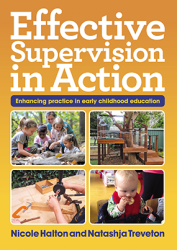
For more support developing your effective supervision practise, read Effective Supervision in Action, and visit Inspired EC.
About the author
Nicole Halton is a passionate early childhood professional with over 20 years of hands-on experience in just about every role you can imagine: from educator and director to author, consultant, approved provider and resource developer. Nicole has made it her mission to help educators rediscover the joy and wonder of childhood through nature play, slow pedagogy, and authentic connection with children.
Since co-founding Inspired EC in 2008, Nicole has inspired countless educators across Australia and beyond with her workshops, books and resources, always encouraging them to embrace the messiness, adventure, and magic that comes with working with young children. When she’s not delivering a training session or putting together a new blog post for the Inspired EC blog, you will typically find Nicole with her head in a book or exploring the outdoors with her family.