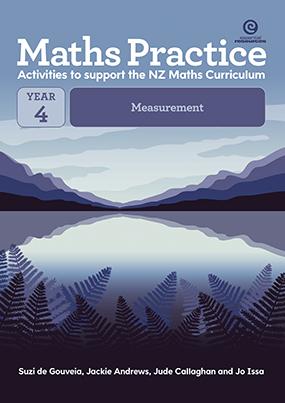
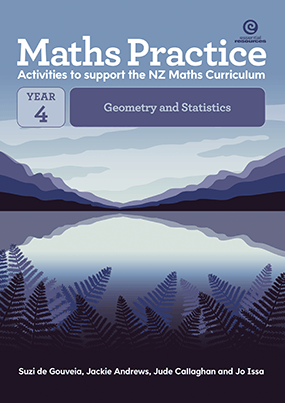
A guide for primary school teachers and leaders in New Zealand implementing the new Mathematics and Statistics curriculum.
You have read the curriculum documents. You have attended the professional development. You know the six strands; you understand the phases of learning – and now comes the hard part: turning all of that into a classroom maths programme that actually works for your students without getting stuck in a script. That’s where structured practice comes in.
This post builds on our earlier overview of Te Mātaiaho and the new NZ mathematics curriculum. Here we focus on one of the most practical questions that Year 4 teachers are asking right now: How do I get my students to actually retain and use what I’m teaching them? The answer lies in the quality, not just the quantity, of the practice you put in place.
What does maths fluency in NZ actually mean in Year 4?
Fluency is one of those words that gets used a lot in education, but it’s worth being specific about what it means in Year 4 in the context of the new NZ Mathematics and Statistics curriculum.
Fluency is not speed for its own sake. It is the ability to apply knowledge accurately, efficiently and flexibly across different contexts. For Year 4 maths in NZ that looks like:
- knowing basic facts in NZ with enough automaticity to free up working memory for problem-solving
- using place value understanding to make sense of larger numbers and estimate reasonably
- applying addition, subtraction, multiplication and division strategies with growing confidence
- beginning to work with fractions and decimals, including tenths, in meaningful ways
- engaging with early algebraic thinking by recognising patterns and relationships.
The Phase 2 maths (Years 4–6) teaching sequence is explicit about the knowledge and practices Year 4 students need to develop across all six strands – Number, Algebra, Measurement, Geometry, Statistics and Probability. Fluency applies across the whole curriculum, and Year 4 is a pivotal year for building it from the foundations set for Phase 1 (Years 0-3).
Research consistently shows that students who achieve genuine fluency at this stage are better placed to engage with the more complex proportional and algebraic reasoning that is expected of them in Phase 3 (Years 7–8). Where that fluency is shaky, the knowledge gap students need to leap grows with every year. Where it is sound, a bridge builds from Year to Year and Phase to Phase – no leap required.
Why does structured maths practice matter more than extra practice?
One of the most common misconceptions about progressive maths practice in NZ is that more is better. It isn’t. What matters is that practice is purposeful, well-sequenced and curriculum aligned.
For example:
- more practice might mean giving students another worksheet on a topic they have already covered, regardless of where that fits in their learning journey
- structured practice means deliberately reinforcing specific knowledge and skills in the order the curriculum introduces them, with enough repetition woven in to support retention over time.
The Education Review Office’s October 2025 report on progress with new curriculum implementation found that Number has been receiving the most classroom attention to start with. This is partly because teacher confidence is understandably stronger in that area. However, the new curriculum makes it clear that all six strands have dedicated year-by-year expectations. Teachers who only prioritise Number risk leaving students without the Measurement, Geometry, Statistics and Probability foundations they also need.
Structured maths teaching practice in NZ means:
- activities that reinforce content in the order it appears in the year-by-year teaching sequence
- strand coverage that spans regular, systematic practice across all six disciplines, not just Number
- spaced repetition which revisits key knowledge over time so that students retain it, not just encounter it once
- purposeful flexibility, the same activity can be used for consolidation, targeted small-group instruction, or independent reinforcement depending on student need.
Systematic, well-targeted practice is one of the highest-impact strategies available to primary teachers.
How do I build maths confidence in primary students who are struggling in Year 4 Maths NZ?
For students who have arrived in Year 4 with gaps from Phase 1, the challenge for teachers to bridge them is real. Those gaps do not disappear – instead they tend to widen if not addressed. But structured practice, used thoughtfully, can make a significant difference.
Here are four practical approaches to support maths for struggling students in NZ.
1. Identify where the gap is
The year-by-year teaching sequence in the Phase 2 curriculum documents gives you a precise map of what students should know at each point. If a student is struggling with place value in Year 4, the sequence tells you exactly where to look back into Phase 1 to find where the gap began, and the stages needed to bridge it.
2. Build in short, frequent practice sessions
Five to ten minutes of focused maths practice at the start of your maths block, targeting a specific skill or knowledge area, is significantly more effective than longer, irregular sessions. Consistency matters more than duration.
3. Use retrieval to make learning stick
Retrieval practice – asking students to recall information without cues – is one of the most well-evidenced strategies for long-term retention. Building short retrieval tasks into your daily maths block (for example, revisiting last week’s basic facts practice before moving to today’s fraction work), makes a measurable difference over time.
4. Make practice activities flexible enough to differentiate
The same practice activity does not have to serve the same purpose for every student. Use it with your whole class for consolidation, with a small group for targeted support, or as an independent task for students who need more repetition. Good curriculum-aligned maths practice resources are designed to flex with you.
What is the role of curriculum-aligned maths practice in Year 4?
One of the frustrations teachers have faced since the new curriculum came into effect is the difficulty of finding NZ maths resources that genuinely reflect the new expectations. Resources that sit outside the year-by-year teaching sequence can quietly work against your progress rather than support it.
When evaluating any maths practice resource for Year 4, ask these questions.
- Does it work through the Year 4 teaching sequence in order?
- Does it cover all six strands, not just the Year 4 Number strand?
- Is it explicitly linked to the new Mathematics and Statistics curriculum – not the 2009 version?
- Was it written by New Zealand teachers who know how the new curriculum works in practice?
- Can it flex across different classroom contexts – whole-class teaching, small-group work and individual catch-up?
These are the criteria that matter when choosing Year 4 maths worksheets in NZ that teachers can genuinely rely on.
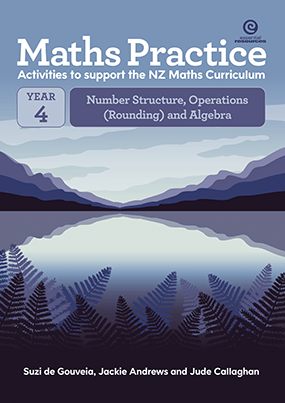
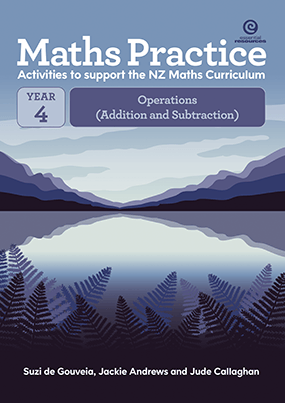
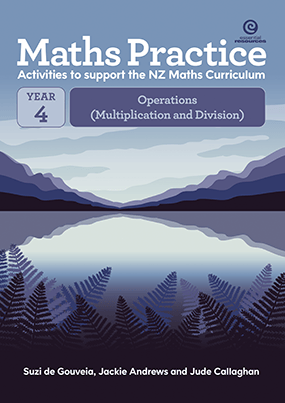
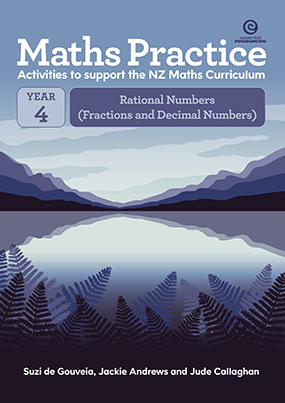
The Essential Resources Maths Practice series for Year 4 has been built specifically to meet these criteria. The series works through the Phase 2 teaching sequence – giving students structured practice in Number, Algebra, Measurement, Geometry, Statistics and Probability. Every book has been developed by a collective of active New Zealand teachers and leaders who understand what implementation looks like day to day – and designed so the activities are useful and usable, straight out of the box.
The six individual books in the Year 4 series each focus on a specific strand or cluster of strands, and answers to all the questions are included:
Including:
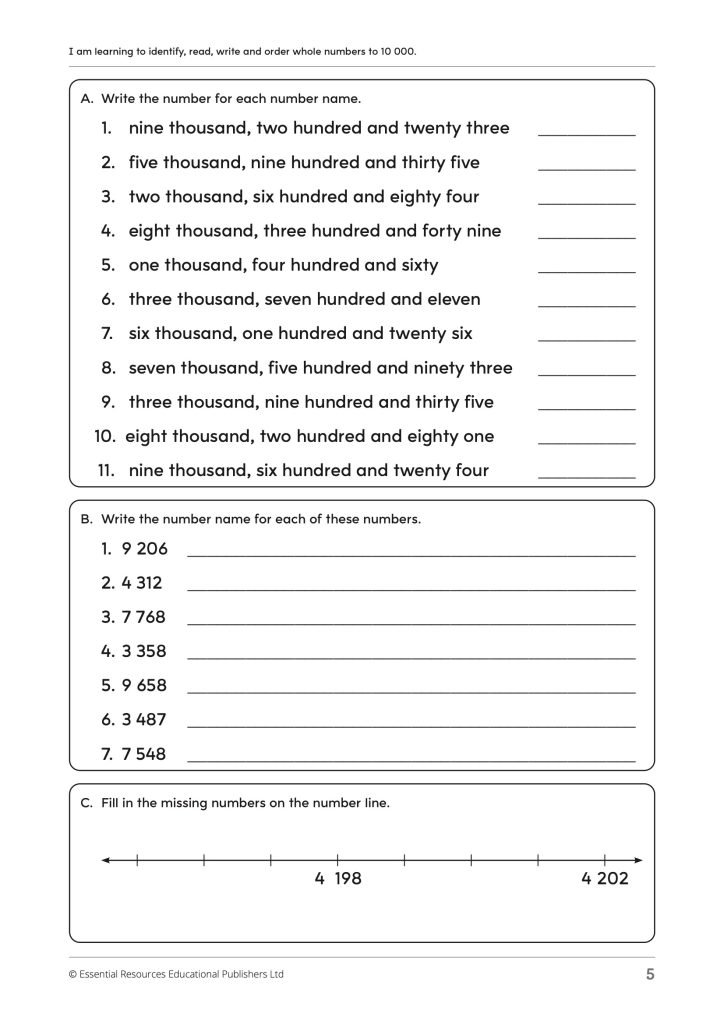
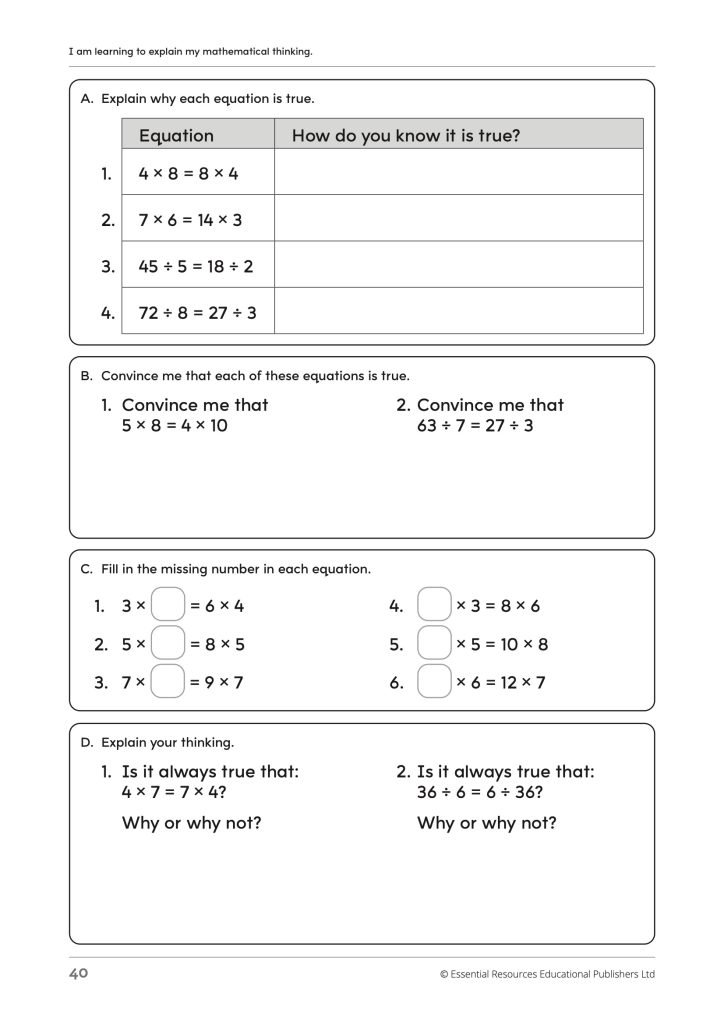
- Number structure
- Rounding whole numbers
- Rounding to the nearest whole number
- Counting forwards and backwards from multiples of the counting unit
- Counting in 10s, 100s and 1 000s from any whole number
- Beginning algebra.
Including:
- Adding and subtracting using place value
- Adding using a number line
- Adding and subtracting using known facts
- Solving subtraction equations using an addition method
- Adding and subtracting using an algorithm
- Choosing the best method to add and subtract numbers
- Solving word problems.
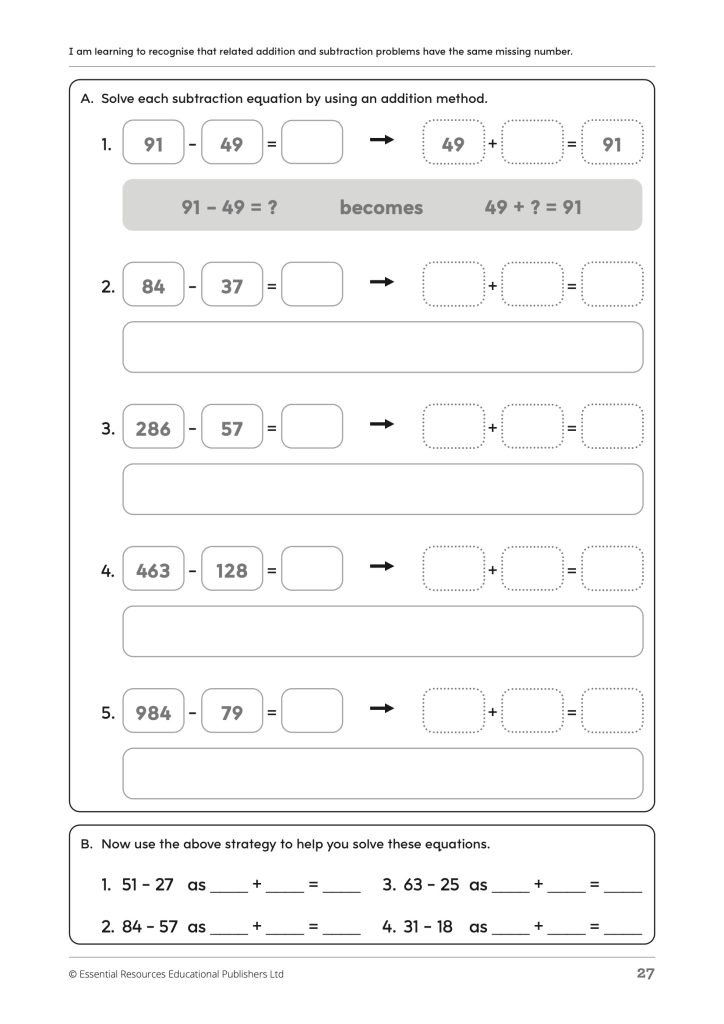
Including:
- Adding and subtracting using place value
- Adding using a number line
- Adding and subtracting using known facts
- Solving subtraction equations using an addition method
- Adding and subtracting using an algorithm
- Choosing the best method to add and subtract numbers
- Solving word problems.
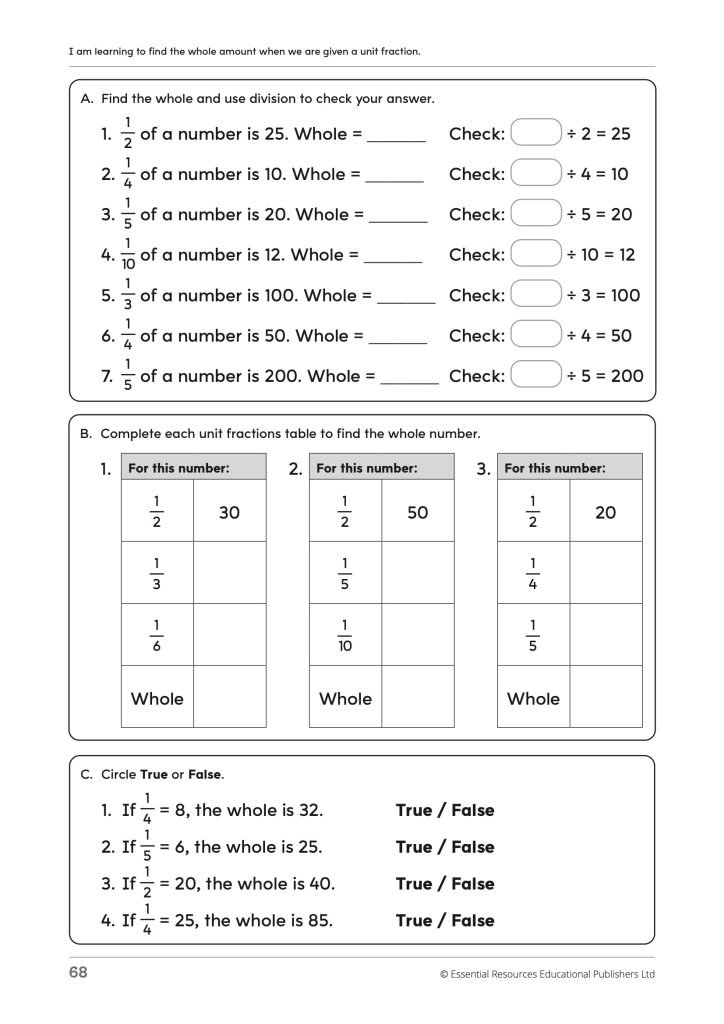
Including:
- Recognising and writing fraction and decimal number names
- Identifying, comparing and ordering tenths as fractions and decimal numbers
- Multiplying and dividing to make whole numbers and tenths
- Comparing and ordering fractions with the same numerator or denominator
- Ordering fractions, improper fractions and mixed numbers
- Comparing fractions
- Adding and subtracting fractions
- Adding and subtracting decimal numbers
- Doubling and halving fractions
- Scaling
- Working with unit fractions.
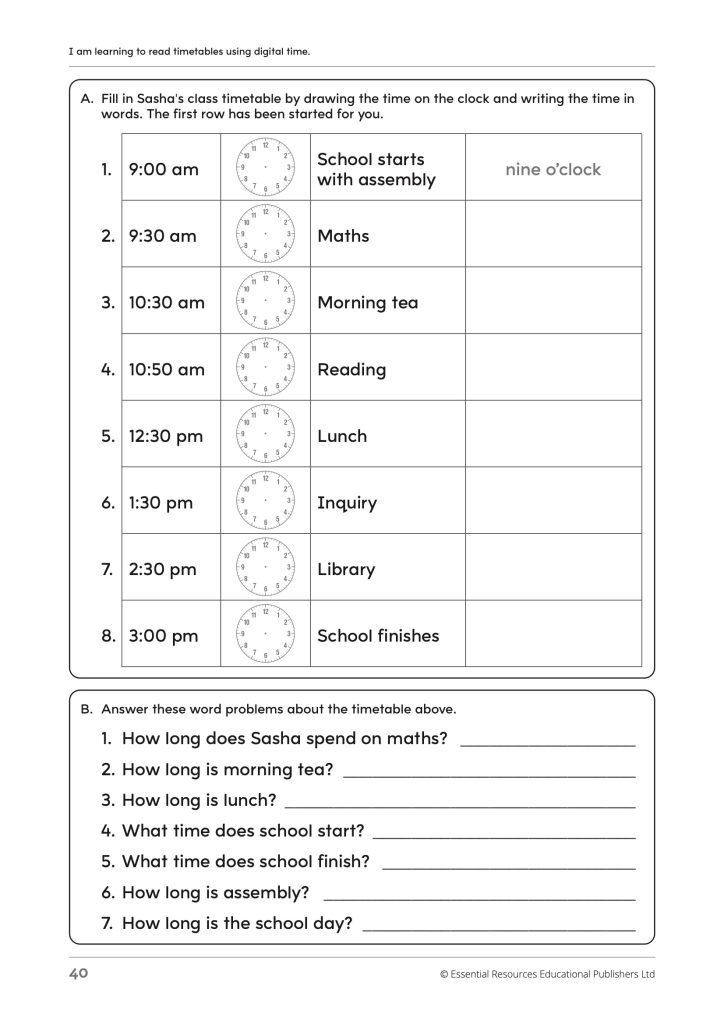
Including:
- Exploring the relationship between estimating and measuring
- Choosing and using appropriate measurement units and tools
- Measuring length
- Measuring weight
- Exploring the relationship between units
- Estimating and measuring capacity
- Measuring temperature
- Measuring the perimeter of a polygon
- Measuring area
- Measuring volume
- Working with angles
- Measuring time
- Measuring duration.
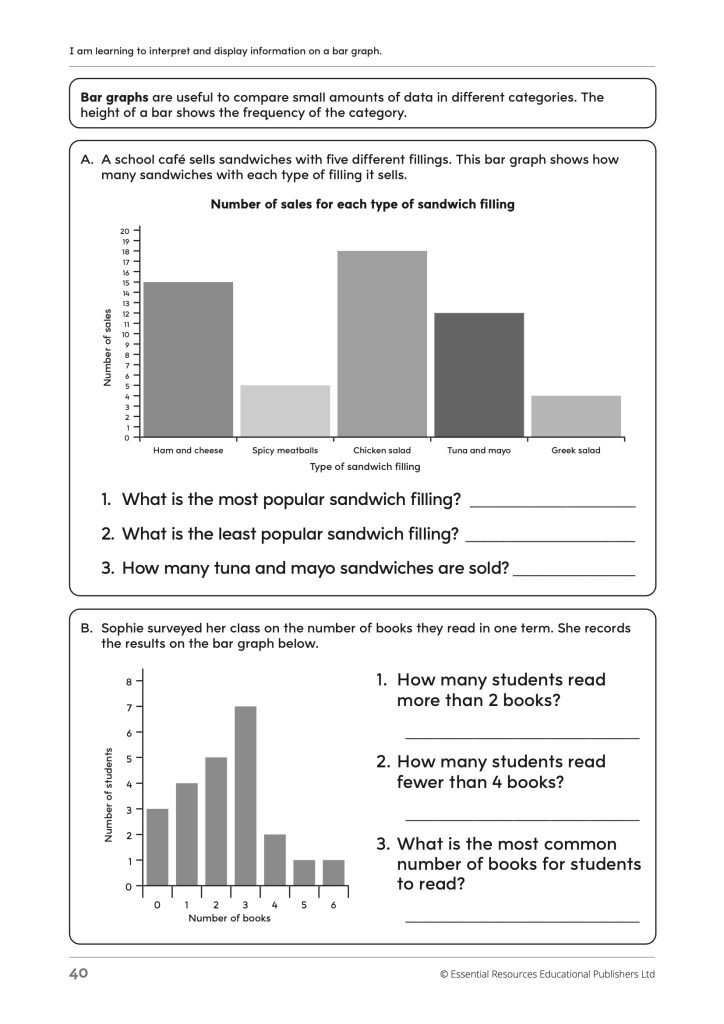
Including
- Exploring the attributes of 2D shapes
- Identifying lines of symmetry in 2D shapes
- Identifying connections between 2D and 3D shapes
- Transforming 2D shapes
- Using coordinates
- Identifying and working with different types of data
- Graphing and interpreting data.
Each book follows the curriculum sequence and reinforces what you teach, as you teach it. For teachers juggling planning, marking and everything in-between, these are resources that work with your programme rather than adding to your workload – giving students the regular, purposeful repetition they need to move from encountering new ideas to applying them.
Year 4 Maths NZ in summary
Maths fluency does not happen after a single encounter with a concept. It is built incrementally through practice that is sequenced to match the curriculum, returned to over time, and varied enough to serve different purposes in your classroom.
At Year 4, the stakes are high. The bridges students build now – in place value, basic facts, fractions, early algebraic thinking in NZ primary and strand-by-strand, will determine how confidently they move through Phase 2 and into Phase 3. Structured practice, done well, is one of the most powerful tools you have for maths achievement in NZ for Year 4 and beyond.